
Welcome to visit AIMA International Group
 Spain
Spain

Your browser version is too low, in order to ensure a better browsing experience,Please click to update to a higher version browser.
Talk about it later.XWelcome to visit AIMA International Group
Spain



.jpg)
Home > News > Industry Trends > The Definitive Jawline Filler Rheology Guide: How Material Properties Shape Long-Lasting, Natural Jaw Contour Results
Industry TrendsHave you ever injected a filler labeled for jawline use, only to watch sharp, defined edges blur and shift in a matter of weeks, even when you placed the product in the correct supraperiosteal plane? Or had patients return with lumps, asymmetry, or that puffy, “overfilled” look along the jaw, despite using a conservative dose? If you have, you already know the problem rarely lies with injection technique alone. Most jawline filler complications trace back to a mismatch between the product’s rheology properties and the physical demands of the lower face.
Global demand for jawline contouring jumped 47% between 2020 and 2024, making it one of the fastest-growing segments in the medical aesthetics space. But as the market floods with new filler products labeled for jawline use, few brands or clinics take the time to dig into the hard, lab-tested rheology data that predicts how a product will perform once it is under the skin. Too many purchasing decisions are based on marketing copy, influencer testimonials, or bulk pricing, instead of the material science that actually drives patient outcomes.
What Exactly Is Filler Rheology, And Why Does It Matter For Jawline Treatments?
Rheology is the study of how materials flow and deform under applied force. For soft tissue fillers, that means measuring how the gel behaves as it pushes through a needle or cannula, how it holds its shape once placed in tissue, how it responds to the constant pull of gravity and movement from facial muscles, and how likely it is to spread or shift over time.
Last year, we connected with a clinic owner in Miami, Florida, who learned this lesson the hard way. She sourced a batch of white-label filler advertised as “high-support jawline contour” from an unvetted overseas supplier, lured by pricing that was 60% lower than her usual brand. She used the product on 17 patients over three weeks. Within a month, 8 of those patients returned to report their jawline definition had completely faded, with soft, squishy collections of gel settled below the jawline near the submandibular glands. Two patients had visible asymmetry from gel shifting to one side. When she sent remaining vials to an independent lab for rheology testing, the results showed the product had a G’ value of just 120Pa, with 35% cohesivity — a formulation designed for soft, superficial injection in areas like the lips or under-eyes, not deep structural support along the jaw. The supplier had never shared third-party test data, relying instead on sleek packaging and vague claims of “long-lasting contour.” The clinic ended up spending $28,700 on hyaluronidase treatments, patient refunds, and reputation management, and its Google review score dropped from 4.9 to 4.1 in six weeks.
Core Rheology Metrics You Must Evaluate For Jawline Fillers
You don’t need a materials science degree to select the right jawline filler, but you do need to know which metrics to ask for when evaluating wholesale products. Skip the marketing buzzwords and ask for lab reports measuring these four non-negotiable parameters:
In 2022, a startup aesthetic brand from London approached our team at AIMA International to help them fix a problem with their first in-house jawline filler line. They had worked with a different manufacturer to create a filler with a G’ of 520Pa, assuming higher G’ would mean better support. When they ran clinical trials with 12 board-certified injectors, 10 reported the extrusion force was so high they could barely push the gel through a 25G needle, leading to inconsistent dosing. Three trial participants developed significant bruising from the extra pressure required to inject, and two developed palpable hard lumps along the jaw that took 8 weeks to resolve. Our R&D team adjusted the crosslink density and gel particle size distribution to land on a formulation with a G’ of 380Pa, tan delta of 0.22, 87% cohesivity, and an extrusion force of 18N. When they re-ran trials, 100% of injectors rated the extrusion feel as “excellent” or “very good,” and 92% of trial participants still had crisp, defined jawlines at their 6-month follow-up, with no lumps or migration.
Matching Rheology To Specific Jawline Treatment Zones
The jawline is not a single, uniform treatment area, and using the same rheology profile across the entire lower face leads to stiff, unnatural results. You’ll need to adjust product selection based on which part of the jaw you are treating:
You will see many brands market a single filler as “suitable for all facial areas,” from tear troughs to jawline. That claim is a red flag from a rheology perspective. Tear troughs require a soft, low-G’ gel (under 100Pa) that moves naturally with the thin under-eye skin, while the jawline needs a firm, high-G’ scaffold. No single gel can hit both parameter ranges at once. Any supplier making that claim will not be able to provide third-party rheology data to back it up.
As an award-winning top 10 global dermal filler manufacturer operating since 2003, AIMA International Group has spent two decades refining filler rheology for specific treatment zones, including jawline contouring. Our Volumafill range is formulated exclusively for deep structural contouring, with rheology properties calibrated to match the exact demands of lower face support.
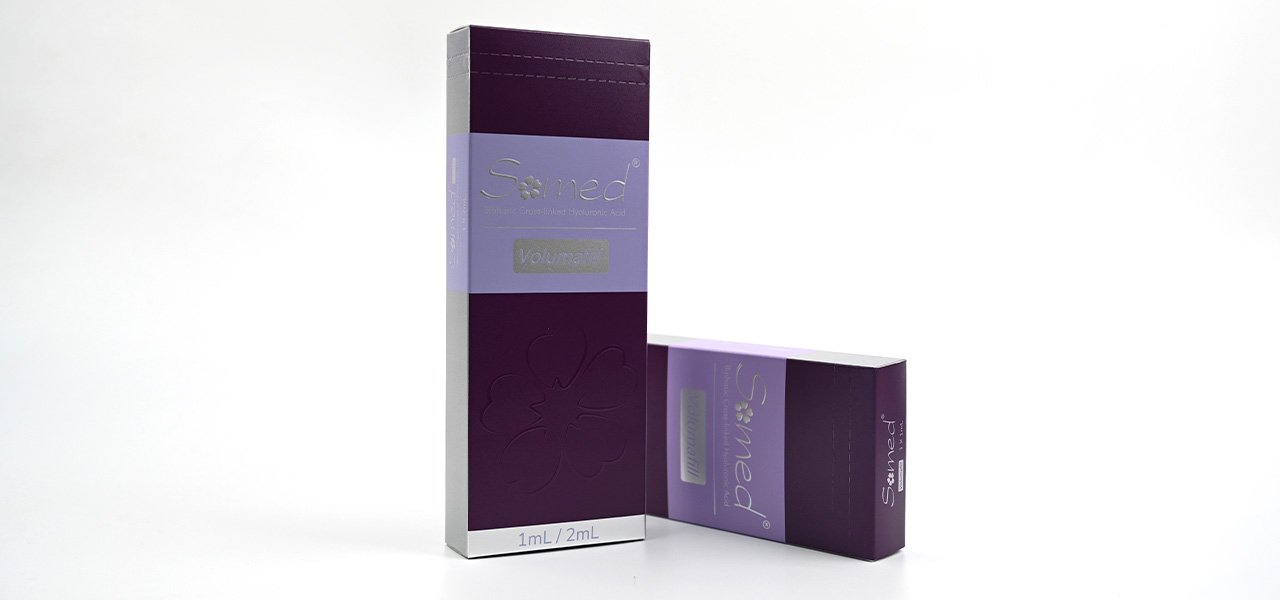
Volumafill is formulated with medical-grade, non-animal derived hyaluronic acid sourced from CE and GMP-certified suppliers, with a raw material value of $45,000 per kg. All raw materials undergo regular third-party testing via SGS to ensure purity and consistency, with no animal-derived ingredients to reduce allergic reaction risk. We use a combination of NASHA and proprietary HICE crosslinking technology to hit a precise rheology profile: 360Pa G’, 0.21 tan delta, 89% cohesivity, and 17N extrusion force. That means it delivers enough firm support to create sharp, long-lasting jawline definition without the rigid, unnatural feel of overly crosslinked fillers, and it pushes smoothly through 27G cannulas to cut down on bruising and patient discomfort. When injected in the correct deep plane, Volumafill maintains its shape for 12-18 months, with no documented cases of migration in our clinical follow-ups, because the high cohesivity keeps the gel anchored exactly where it is placed.
Verified Rheology Data: Non-Negotiable For Wholesale Filler Purchases
When you source jawline fillers for your clinic or brand as part of medical aesthetics wholesale procurement, you carry full liability for patient outcomes. That means you cannot rely on marketing claims to select products. You need full, batch-specific rheology reports from independent labs, plus full compliance documentation to meet regulatory requirements in your market.
AIMA International operates a 4,800 square meter modern production base with Class 100 GMP cleanrooms and 3 dedicated production lines, with an annual production capacity of 5 million units and monthly output of up to 50,000 units.
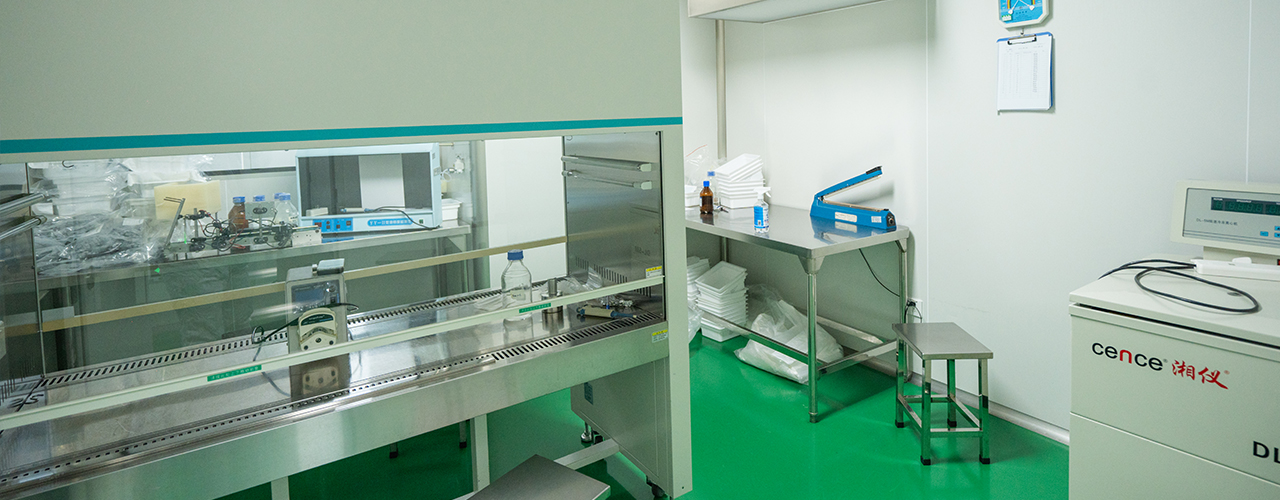
Our production processes follow ISO 13485 quality management standards and Class III medical device manufacturing specifications, with full CE certification and FDA VCRP registration for all our core filler lines. Every batch of Volumafill undergoes independent rheology testing before it leaves our facility, and all wholesale partners receive full access to batch-specific test reports, quality documentation, and regulatory paperwork to support local market registration. We do not hide data behind vague marketing language — you get the exact G’, tan delta, cohesivity, and extrusion force numbers for every shipment, so you can train your injectors properly and set realistic patient expectations.
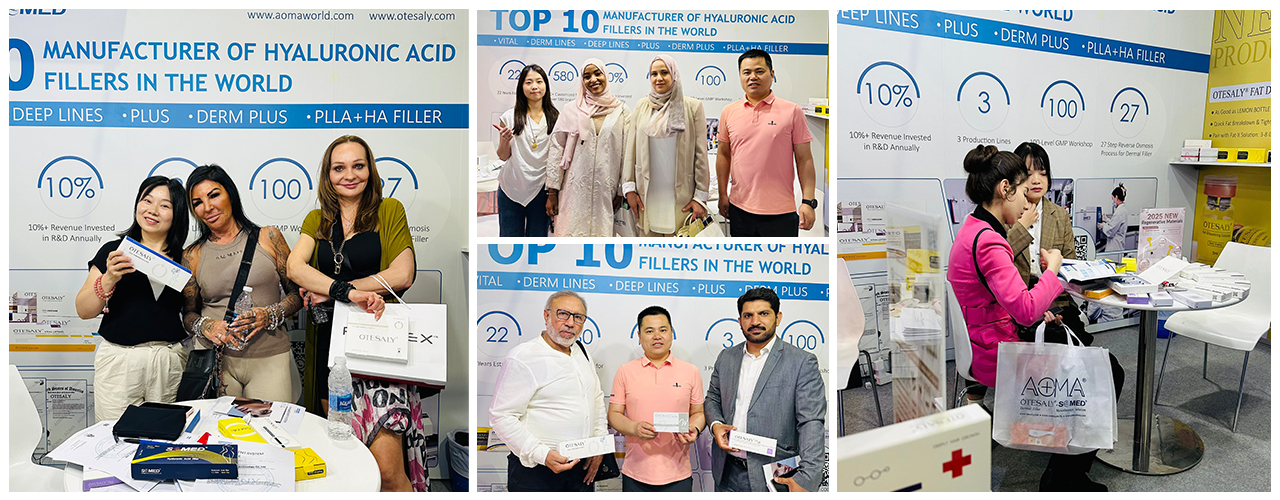
For OEM and ODM partners, we offer end-to-end support covering every step of product development, from brand positioning, logo design, and custom packaging to fully customizable rheology profiles, drawing on our library of over 1000 mature formulations. We can adjust crosslink density, gel particle size, HA concentration, and lidocaine content to match your brand’s exact positioning, whether you are building an entry-level line for new injectors or a premium contouring line for high-end clinics. Our partnership model is built for flexibility, with no MOQ pressure for emerging brands and tiered volume discounts for large enterprise clients. Sample orders ship in 3-5 business days, bulk orders deliver in 15-20 days, and we offer expedited production options for time-sensitive product launches. To date, we have delivered custom filler solutions for 521 brands across 62 countries, with our products featured at top global industry events including the Dubai Beauty Exhibition.
Common Rheology-Related Mistakes To Avoid
Our support doesn’t end when a shipment leaves our warehouse. All wholesale partners get access to our clinical training team, which provides guidance on matching Volumafill’s rheology profile to the right injection techniques, cannula selection, and dosing protocols to minimize adverse events. We offer full batch traceability for every product, and our compliance team can help you navigate regulatory requirements for markets across North America, Europe, the Middle East, and Southeast Asia. We don’t promise miracle results or permanent fixes — we deliver consistent, data-backed filler formulations, transparent manufacturing practices, and the support you need to deliver natural, long-lasting jawline results your patients will be satisfied with.

Copyright @ 2026 AIMA International Group Co., Ltd.