
Welcome to visit AIMA International Group
 Spain
Spain

Your browser version is too low, in order to ensure a better browsing experience,Please click to update to a higher version browser.
Talk about it later.XWelcome to visit AIMA International Group
Spain



.jpg)
Home > News > Industry Trends > Monophasic vs Biphasic Dermal Fillers: Key Differences, Clinical Uses & How to Choose
Industry TrendsHave you ever wondered why two hyaluronic acid (HA) dermal fillers, both marketed for midface volume loss, can leave one patient with smooth, natural results and another with visible lumps, uneven texture, or product migration? The difference rarely comes down to practitioner skill alone. Most of the time, it traces back to a core formulation difference that even many new injectors overlook: whether the filler is monophasic or biphasic.
For brands building an aesthetic product line, or clinic owners sourcing wholesale dermal fillers, mixing up these two formulation types can lead to poor patient outcomes, negative reviews, and wasted inventory. This guide breaks down the structural, performance, and clinical differences between monophasic and biphasic fillers, walks through real-world case examples of selection missteps, and explains how to source formulations that match your client base’s needs.
All crosslinked HA dermal fillers use BDDE or other globally approved crosslinkers to bind HA molecules together, extending product longevity from a few days (for uncrosslinked HA) to 6-18 months in tissue. The way crosslinked HA is processed after the crosslinking reaction creates the monophasic/biphasic divide that drives performance differences.
Biphasic dermal fillers were the first generation of crosslinked HA fillers to reach the global market, popularized by early NASHA (Non-Animal Stabilized Hyaluronic Acid) technology in the 1990s. The term “biphasic” refers to two separate components in the final syringe:
Because crosslinked HA exists as discrete particles, biphasic fillers have firmness levels tied directly to particle size. Larger particles (280-500μm) are designed for deep supraperiosteal placement, like cheekbone or jawline augmentation, while smaller particles (100-250μm) work for mid-dermal lines like nasolabial folds. One tradeoff: if particles are not evenly sieved, or injected too superficially, they can create palpable nodules or a granular feel under thin skin.
Monophasic dermal fillers entered the market later, developed to address texture and integration complaints around early biphasic products. Instead of separating crosslinked particles from a liquid carrier, monophasic fillers consist of a single, homogenous, interconnected gel matrix, with no distinct particle/carrier split.
Manufacturers adjust firmness and elasticity of monophasic gels by tuning crosslink density, rather than sifting particle sizes. This creates a smoother, more cohesive gel that spreads evenly under the skin without clumping. Many monophasic formulas also integrate more seamlessly with surrounding soft tissue, leading to a natural “your skin but better” feel for patients. That smooth integration comes with a tradeoff, too: low-cohesion monophasic fillers can migrate if placed in high-movement areas without precise injection technique, because the continuous gel can shift with repeated muscle movement over time.
You don’t need a lab to tell the difference between a well-made monophasic and biphasic filler. Practitioners and brand owners can evaluate key performance metrics directly from a syringe, which correlate directly to clinical performance:
Formulation choices don’t just matter on a lab data sheet. They directly impact patient satisfaction, as two recent cases from our wholesale clinic partners illustrate.
The first case involved a 38-year-old patient who visited a small medspa for tear trough correction. The injector used a low-cost, unvetted biphasic filler with poorly sieved 200μm particles, injected just 1mm under the thin tear trough skin. Within two weeks, the patient developed visible blue discoloration (the Tyndall effect) and small, palpable nodules along the infraorbital rim. The particles were too large and uneven for the thin, delicate periorbital skin, and the non-crosslinked carrier absorbed quickly, leaving clumps of crosslinked HA visible under the surface. The patient required two rounds of hyaluronidase to dissolve the product, and the medspa lost three regular clients from the negative word of mouth.
The second case centered on a 29-year-old patient seeking natural lip augmentation. The injector chose a very soft, low-cohesion monophasic filler marketed for fine lines, injecting 1ml across the upper and lower lip. Because the gel had low internal cohesion and spread easily, the product migrated upward into the philtrum and outward past the vermilion border within six weeks, leaving the patient with uneven, disproportionate lip shape that did not match her desired results. The injector later corrected the issue by dissolving the migrated product and using a mid-cohesion monophasic formula designed specifically for perioral use, but the patient reported waiting three months to feel comfortable in public photos again.
There is no universal “better” option between the two formulation types. The right choice depends entirely on the treatment area, patient’s skin thickness, desired outcome, and injector technique. Most well-stocked clinics carry a mix of both to cover all patient needs.
Best uses for biphasic fillers:
Best uses for monophasic fillers:
Sourcing well-formulated monophasic and biphasic fillers doesn’t have to mean paying premium prices for big-name brands. As a top global dermal filler manufacturer, AIMA International Group Co., Ltd. has produced both monophasic and biphasic HA fillers since its founding in 2003, earning a spot among the Top 10 Dermal Filler Manufacturers in the global aesthetic industry.
The company’s R&D team holds a library of over 1,000 mature aesthetic formulas, and has mastered both core HA processing technologies: NASHA technology for consistent, high-lift biphasic fillers, and proprietary HICE technology for smooth, cohesive monophasic gels that resist migration and integrate seamlessly with soft tissue. All HA raw materials are medical-grade, non-animal sourced, with a purity level matching the industry’s highest standards (valued at $45,000 per kg), sourced from CE and GMP-certified suppliers that undergo regular third-party testing from SGS and other global auditors.
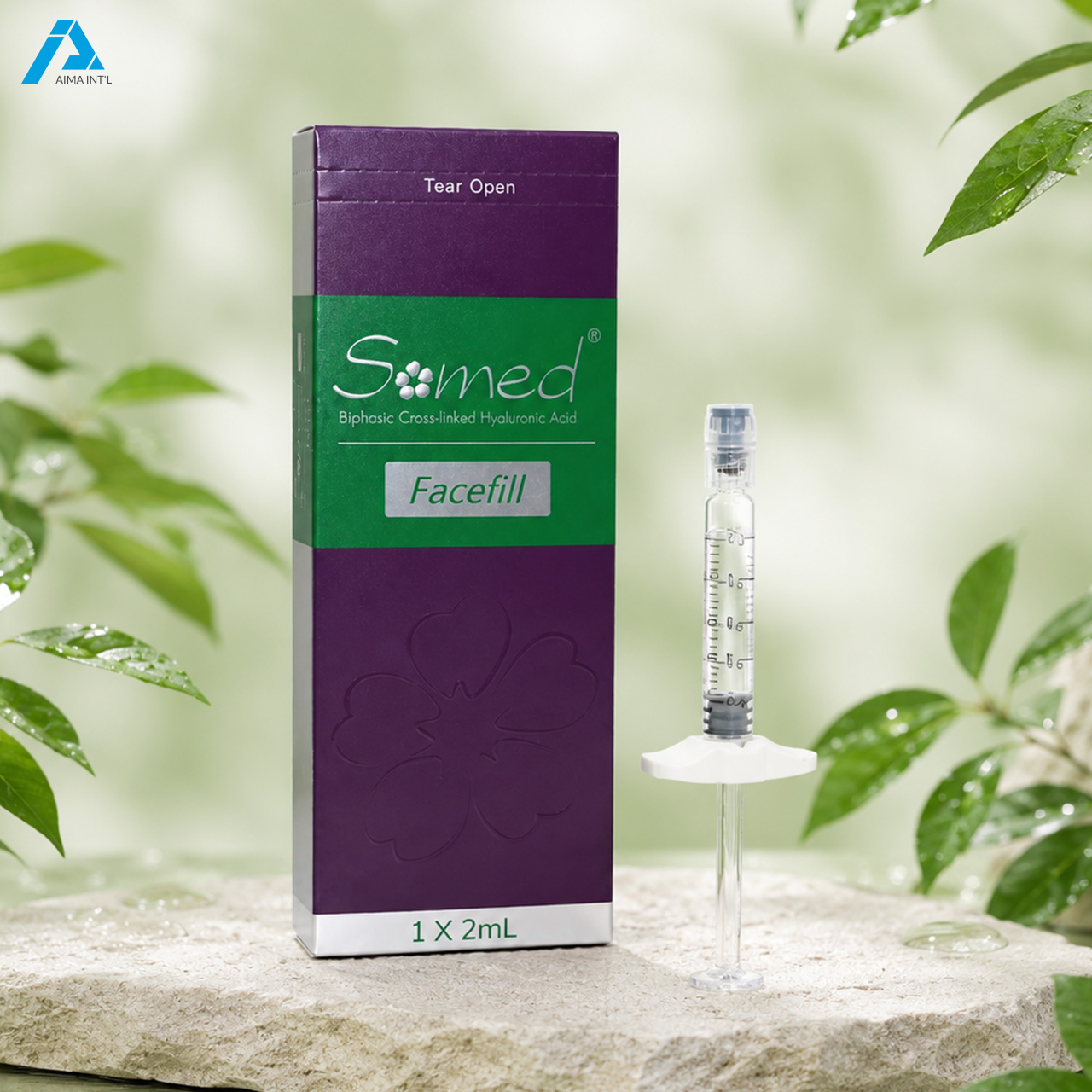
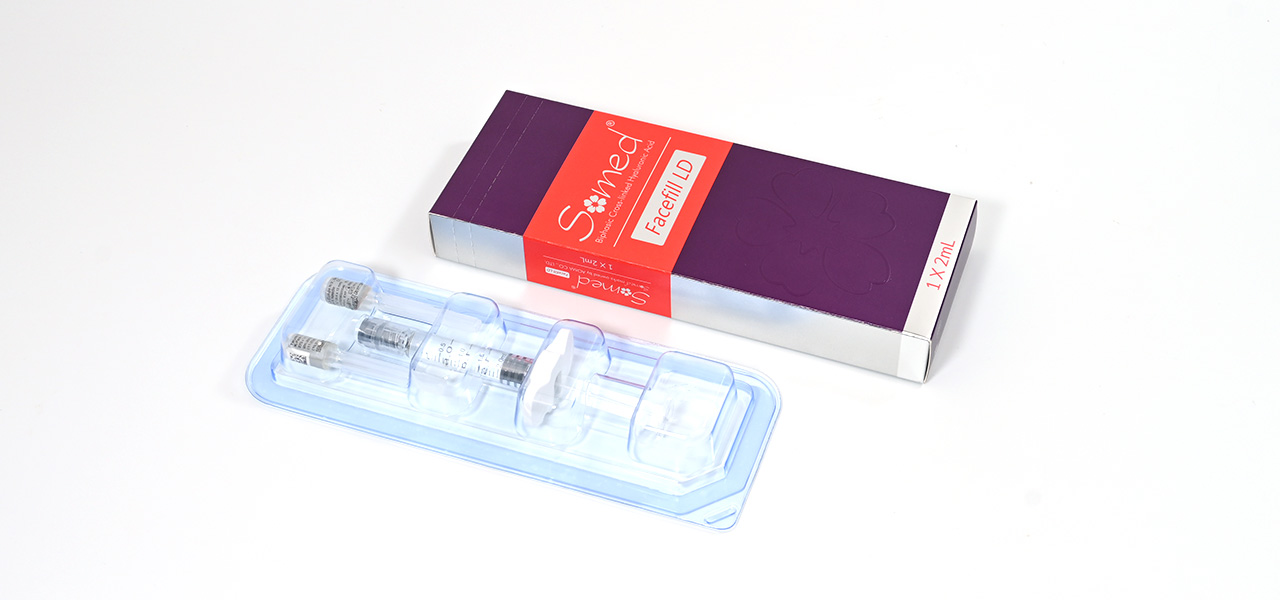
One of the brand’s most popular formulations for mid-face and perioral use is Facefill Lidocaine, a smooth biphasic HA filler optimized for natural results across a wide range of treatment areas.
Formulated with 0.3% lidocaine to reduce patient discomfort during injection, Facefill Lidocaine uses HICE crosslinking technology to balance optimal G’ for mild to moderate lift, high cohesivity to resist migration, and a smooth, particle-free texture that eliminates the risk of granular nodules in thin skin. The formula works for everything from nasolabial fold correction to lip augmentation and mild under-eye hollow correction, making it a versatile staple for clinics that want to reduce SKU bloat without sacrificing result quality.
AIMA operates a 4,800 square meter modern production facility with Class 100 GMP clean rooms and 3 dedicated production lines, running under strict ISO 13485 quality management systems and Class III medical device production standards.

The facility produces up to 5 million filler units annually, with a monthly output capacity of 50,000 units, to support both small emerging brands and large global aesthetic distributors. Unlike many wholesale suppliers that enforce rigid high minimum order quantities, AIMA offers No MOQ Pressure flexible cooperation terms for new brands building their first product line, alongside volume discounts for large enterprise clients. The team provides end-to-end OEM/ODM support, from brand positioning, logo design, and custom packaging to tailored formula adjustments (including crosslink density, HA concentration, and lidocaine addition) to match a brand’s target audience. Sample orders ship in 3-5 working days, while bulk orders deliver in 15-20 days, with expedited production options available for time-sensitive launches.
To date, AIMA has provided custom dermal filler solutions for more than 521 brands across 60+ countries, with a client retention rate of over 82% across 20 years of operation.

All AIMA dermal fillers hold full international compliance documentation, including EU CE certification and US FDA VCRP registration, with full batch traceability for every shipped unit. For Medical Aesthetics Wholesale partners, AIMA assigns a dedicated account manager to walk through every step of the ordering process, from formula selection to post-delivery support, with full access to compliance documents for every SKU. The team also provides free injector training resources to help clinic partners reduce complication rates and improve patient outcomes. Unlike suppliers that cut corners on raw material purity or crosslinking consistency to cut costs, AIMA runs 12 separate quality checks on every batch of filler, from raw material testing to final syringe sealing, to ensure every unit delivers consistent, predictable results.
Many new brand owners make the mistake of stocking only bifásico fillers, assuming the newer formulation is universally preferred. But data from AIMA’s client network shows that clinics carrying a balanced mix of bifásico (like Facefill Lidocaine) and monofásico (like Volumafill) see 27% higher average patient satisfaction scores, because they can match product structure to each patient’s unique anatomy, rather than forcing a one-size-fits-all formula on every case.
If you’re sourcing fillers for your clinic or brand, ask suppliers for specific data on gel cohesivity, G’ values, and particle size (for biphasic formulas) before placing a bulk order. Avoid suppliers that refuse to share third-party purity testing or regulatory documentation, as these products are far more likely to cause the nodule, migration, and discoloration issues seen in the earlier case studies.
The monophasic vs biphasic filler debate doesn’t have a single winner. What matters is consistent formulation quality, transparent manufacturing, and matching the right gel structure to the right patient. For brands and clinics looking to build a reliable, high-performing filler line, working with a manufacturer that understands both formulation types, and can back every product with full compliance and quality data, removes much of the guesswork from sourcing.

Copyright @ 2026 AIMA International Group Co., Ltd.