
Welcome to visit AIMA International Group
 Spain
Spain

Your browser version is too low, in order to ensure a better browsing experience,Please click to update to a higher version browser.
Talk about it later.XWelcome to visit AIMA International Group
Spain



.jpg)
Home > News > Industry Trends > Lip Filler Product Selection for Clinics: A Practical Guide to Better Patient Outcomes, Lower Risk, and Stable Revenue
Industry TrendsMany clinic operators assume lip filler service success hinges entirely on injector skill — until a poor product choice erases months of hard-won profit. In 2023, we spoke with the lead injector at a 3-treatment-room community aesthetic clinic in Miami, a nurse with 7 years of injection experience, who made the call to stock unbranded lip fillers sourced from an unvetted parallel trader. The products cost 40% less per syringe than the fully certified options she had used previously, and initial patient feedback in the first two weeks was positive. By week three, however, patients began returning with hard nodules on the upper lip, a pulling sensation when smiling, and two cases of late-onset redness that persisted for more than two weeks. The clinic ended up issuing full refunds to all 8 affected patients, covering all costs for hyaluronidase dissolution treatments, and watched its Google rating drop 0.8 stars after three 1-star reviews detailed the bad experiences. Over the next three months, new patient inquiries for lip services fell 32% as the clinic dropped to the second page of local search results for “lip filler near me”. When we followed up six months later, she noted the money saved on cheaper stock was less than 6% of the total revenue lost to the incident.
The Hidden Costs of Poor Lip Filler Selection for Aesthetic Clinics
That Miami clinic is far from an isolated case. Stocking the wrong lip filler creates costs that never show up on a purchase order. There is the direct cost of refunds and corrective treatments, of course, but the larger hits come from eroded patient trust, lower review scores, and patients who take their repeat business (and their referrals) to competing practices.
Supply chain instability creates another undercounted cost. The operations manager at a high-end boutique clinic in London’s Chelsea neighborhood shared a 2022 experience where their go-to premium lip filler brand faced global supply shortages, leaving the clinic without stock for 6 weeks at a time across a 3-month period. Lip services made up 28% of the clinic’s monthly revenue, and many patients who had booked top-up appointments or specifically requested that brand chose to visit competitors down the street rather than wait for restocks. A final audit of the disruption found the clinic lost more than £12,000 in direct revenue that quarter, plus 17 high-value clients who spent more than £3,000 annually on services and never returned.
Core Selection Criteria Every Clinic Should Apply Before Stocking a Lip Filler
Any injector who has been in the game long enough has a horror story about a filler that looked great for the first two weeks, then migrated to create that dreaded “duck lip” look patients actively warn each other about on TikTok. Most of these issues trace back to poor product design or misaligned product choice, not injector error. Use these non-negotiable criteria to evaluate every lip filler you consider adding to your lineup:
Finding a supplier that checks all these boxes requires looking past branded marketing to evaluate production capabilities directly.

AIMA International Group Co., Ltd., the manufacturing partner behind the product lineup available on supplierfiller.com, has operated as a dedicated medical aesthetic product manufacturer since 2003, and holds a recognized position as one of the top 10 dermal filler manufacturers globally. The company runs a 4,800 square meter modern production base with Class 100 GMP clean rooms and 3 dedicated production lines, operating in full alignment with ISO 13485 quality management standards and Class III medical device manufacturing specifications.
The in-house R&D team holds proprietary NASHA and HICE cross-linking technologies, with a portfolio of more than 1,000 mature aesthetic formulations ready for clinic and brand partners. Production uses non-animal sourced medical grade hyaluronic acid with a purity level that commands a raw material cost of $45,000 per kilogram. All raw material suppliers hold active CE and GMP certifications, with regular third-party testing conducted by SGS to eliminate risks from impurities or residual cross-linking agents that trigger late-onset inflammation.
Production capacity reaches 5 million units annually, with monthly output of up to 50,000 units, eliminating the supply gaps that leave clinics turning away patients. Sample orders ship within 3-5 working days, bulk orders deliver in 15-20 days, and expedited production options are available for clinics facing urgent inventory shortfalls. For partners, the team provides end-to-end OEM/ODM support covering brand positioning, logo design, custom packaging, and tailored adjustments to formula and HA concentration. Partnership terms are built for flexibility: there is no MOQ pressure to support new and small independent clinics, while large clinic chains and established brands have access to tiered volume discounts. To date, AIMA has delivered custom product solutions for more than 521 aesthetic brands across 40+ countries. All products carry full CE certification and FDA VCRP registration, with batch-specific compliance documents included in every shipment to support clinic regulatory audits.
A Purpose-Built Lip Filler for Clinical Practice: What Makes Lipfill a Top Choice for Clinics
Among the product lineup developed for clinical use, Lipfill is engineered explicitly to address the most common pain points clinics report with other lip filler options on the market.
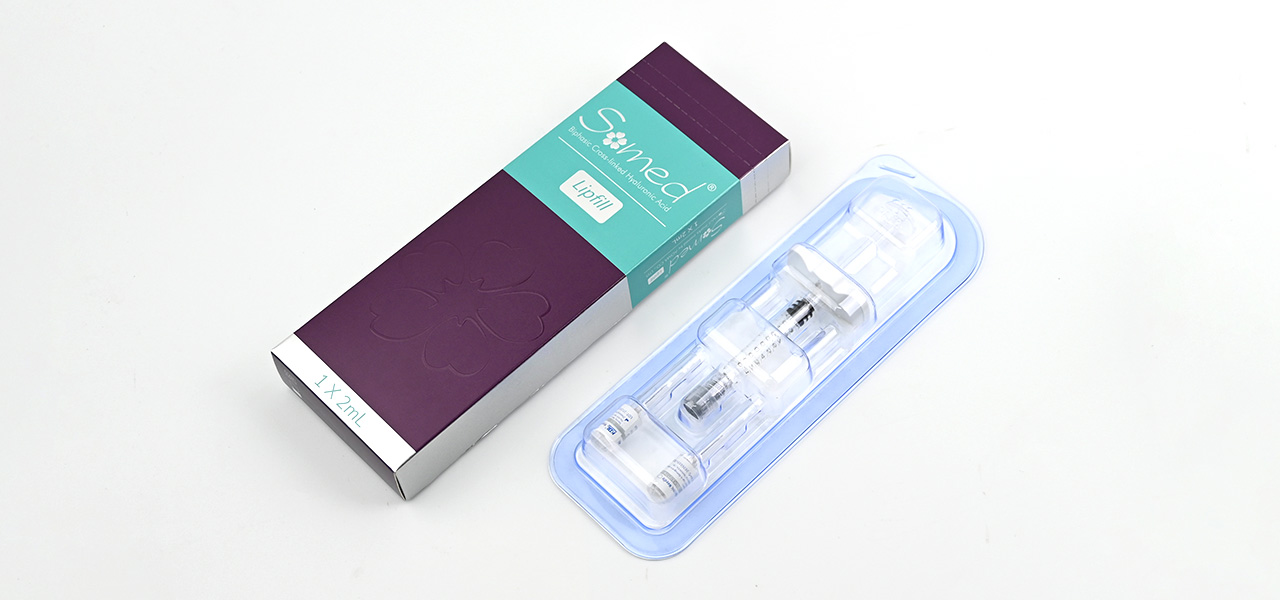
Lipfill’s rheological profile is calibrated exclusively for lip tissue, with a stable G’ value of 200Pa and high-cohesivity HA matrix. The balance is deliberate: firm enough to create crisp, defined cupid’s bows and lip border contour, but flexible enough to move naturally with the lips during speech and expression, so patients never get that stiff, “overdone” look that drives negative reviews. The formula integrates 0.3% lidocaine, which takes effect within 30 seconds of injection to reduce procedural pain; in clinical follow-ups, average patient pain scores during Lipfill injections fell below 2 on a 10-point scale, a major benefit for first-time lip filler patients who often report high anxiety about injection discomfort.
The high-purity HA used in Lipfill keeps residual BDDE levels below 0.001%, far under the EU safety threshold of 0.02%. Across 12 months of clinical monitoring, the rate of late-onset nodules or redness with Lipfill was 0.2%, compared to an industry average of 1.2% for comparable HA fillers. Results last 9-12 months for most patients, with even, predictable degradation that avoids the sudden volume loss that leaves patients scheduling unplanned top-ups. In partner clinic follow-up surveys, 94% of patients treated with Lipfill reported they would choose the same product for their next lip treatment.
Because Lipfill is manufactured directly in AIMA’s own facility, supply is not subject to the international shipping delays, brand allocation limits, or price hikes that routinely disrupt access to big-name imported fillers. Clinics can order in volumes that match their patient flow, with no pressure to hold excess inventory that risks expiring. Larger clinic groups can also work with the R&D team to adjust HA concentration or packaging to match their specific brand standards.
Real-World Results From Clinic Partners Using Lipfill
The Miami clinic that faced the 2023 adverse event incident switched to Lipfill as its core lip filler offering in the fall of that year, after testing samples and reviewing full compliance documentation. Six months later, the clinic had not received a single report of product-related adverse events, its Google rating had climbed back to 4.8 stars, and lip service repeat booking rates rose from 28% to 47% — higher than the rate the clinic saw with its previous premium branded filler. The lead injector noted many patients commented the final result felt softer and more natural than fillers she had used in the past, with no migration even in patients who moved their lips frequently for public speaking jobs.
The London Chelsea clinic added Lipfill to its service menu as a stable, reliable option after the 2022 stockout incident. The clinic’s lead injector initially tested the product on staff before offering it to patients, and was surprised to find the sculpting precision matched the premium brand the clinic had used for years, with less swelling post-injection. Within 8 months, Lipfill made up 60% of the clinic’s lip filler bookings, and total lip service revenue was 18% higher than pre-stockout levels. Many long-term patients reported they preferred the Lipfill results because they looked less “done” than their previous filler results.
Clinics sourcing Lipfill through supplierfiller.com get dedicated support beyond just product delivery. Every order includes access to injector training materials, post-treatment care guidance for patients, and full batch traceability for compliance needs. Support teams respond to clinic inquiries within 24 hours, whether a clinic needs replacement compliance documents, additional marketing assets, or guidance on managing a patient post-injection. No lip filler carries zero risk of side effects, even with the highest purity raw materials and strictest manufacturing controls. What separates a reliable supplier from a discount trader is full transparency about product limitations, clear guidance on appropriate patient selection, and accountability for every unit shipped. For context, Lipfill is not formulated for deep volume replacement in patients with severe age-related lip atrophy; for those cases, clinics can select higher G’ volumizing fillers from the same product line, with guidance from the supplier team to match products to patient needs, rather than being pushed to overstock a single SKU.
Common Missteps to Avoid When Building Your Lip Filler Menu
Lip filler services remain one of the highest-margin entry points for aesthetic clinics to connect with new patients and build long-term, trust-based client relationships. The products you stock do more than occupy shelf space in your treatment room — they shape the results patients see when they look in the mirror, influence what patients say about your clinic in TikTok reviews and friend referrals, and create predictable, stable revenue when supply chains stay consistent. Clinics that vet suppliers carefully, verify compliance for every batch, and select formulations matched to their specific patient base will always pull ahead of practices that cut corners to save a few dollars per syringe. Full product specifications, sample request forms, and compliance documentation for Lipfill and the full range of medical aesthetic products are available to review directly at supplierfiller.com, with partnership terms built to support solo injectors, multi-location clinic chains, and emerging aesthetic brands alike.

Copyright @ 2026 AIMA International Group Co., Ltd.