
Welcome to visit AIMA International Group
 Spain
Spain

Your browser version is too low, in order to ensure a better browsing experience,Please click to update to a higher version browser.
Talk about it later.XWelcome to visit AIMA International Group
Spain



.jpg)
Home > News > Industry Trends > What Is G Prime in Dermal Fillers? A Complete Guide for Aesthetic Practitioners & Brand Owners
Industry TrendsHave you ever run into this scenario? You order a batch of dermal fillers marketed as “high-support, long-lasting contour” products, and the first shipment delivers sharp, defined jawlines that hold for over a year. The second shipment? The product spreads within a month, leaving patients with soft, undefined jowls where a sharp chin should be. Or maybe the filler feels firm when pushed through the needle, leading you to believe it has strong support, but once injected in the nasolabial fold, it forms hard lumps that bulge every time a patient smiles, impossible to massage flat.
Nearly all these issues trace back to a single parameter rarely placed front and center on product marketing sheets: G Prime. Many brand owners and clinic purchasers select fillers based on obvious, easy-to-market metrics: hyaluronic acid concentration, crosslinking rate, lidocaine content. They pay little mind to actual G Prime values or batch-to-batch consistency, and end up dealing with costly clinical fallout.
In fall 2023, a startup founder from Barcelona reached out to our team. She and her two co-founders, all former aesthetic nurses with six years of clinical experience, had spent two years saving to launch their own dermal filler line. They placed their first 10,000-unit order with a local contract manufacturer that quoted prices 20% below the industry average. The samples tested well—she injected the product into her own malar area, and found the support and softness matched her expectations. But once the full batch launched, issues rolled in fast. Of the first 1,200 units sold, 380 customers reported that their apple cheeks had shifted downward within two weeks. They could feel the gel moving under the skin when they smiled, and the product that should have sat high on the cheekbone slid down to pool above the nasolabial fold, creating odd, puffy ridges. They sent remaining units to a third-party rheology lab for testing. The product, labeled as a 24mg/ml high-support filler, had a G Prime value of just 117Pa at the 37℃ temperature that mimics human body heat—too low to even meet the minimum standard for mid-G fillers. It was a threefold drop from the 372Pa measured in the pre-production sample. That bad batch cost them nearly 80,000 euros in refunds and reputational damage. They lost almost half of their 12,000 Instagram followers, and came close to shutting down entirely.
In early 2024, a purchasing manager from a chain of clinics in Dubai’s Jumeirah Beach neighborhood shared a story from the opposite end of the spectrum. His team had sourced a batch of “maximum strength contour filler” from a cross-border trader, priced 40% lower than legitimate, branded alternatives. They used the product for nasolabial fold and jawline injections in 27 patients. Nineteen of those patients returned within a week, reporting hard lumps at injection sites that bulged when they smiled or talked, with none of the soft give of natural tissue. One patient, a local lifestyle creator, posted a TikTok documenting her bad experience that racked up 1.2 million views. The clinic’s online booking volume dropped 60% overnight. Lab testing on the filler showed a G Prime value of 760Pa, with a G’/G” ratio of 8.7—far outside the 3-5 range compatible with soft facial tissue. The product was little more than an over-crosslinked block of HA gel, incapable of integrating with surrounding tissue once injected.
Short for elastic storage modulus, G Prime is a core rheology metric measuring a material’s elastic properties. In the context of dermal fillers, it quantifies how well the gel bounces back to its original shape after being compressed by external force—whether that force comes from facial muscle movement during expression, or the constant downward pull of gravity on soft tissue. A common misconception conflates G Prime with filler firmness or extrusion force, but these are entirely separate metrics. Extrusion force measures how much pressure is needed to push gel through a needle; a filler that feels firm to push may not have high G Prime, it may simply be formulated to be thicker. G Prime describes the gel’s resistance to deformation once implanted under the skin, and is the real metric that determines whether a filler will hold its shape over time.
The counterpart to G Prime is G”, or loss modulus, which measures a gel’s viscous, flowable properties. The ratio between G Prime and G” determines whether a filler behaves more like a resilient solid or a runny liquid once injected. A ratio that is too high leaves patients with stiff, plastic-like lumps that look unnatural during expression. A ratio that is too low means the gel will spread through tissue planes easily, offering no meaningful structural support.
Over two decades of clinical use, the aesthetic industry has established widely accepted G Prime ranges matched to specific injection depths and treatment areas:
Working with hundreds of brands and clinics globally, we have seen consistent gaps in G Prime literacy that translate directly to lost revenue and damaged reputations.
Myth 1: Higher G Prime = better filler. There is no universal “best” G Prime value, only values matched to the right use case. Injecting a 500Pa high-G filler for fine under-eye lines will guarantee nodules and Tyndall effect. Injecting an 80Pa low-G filler for chin augmentation will guarantee migration and lost definition. It is no different from choosing footwear: running shoes work for marathons, hiking boots work for mountain trails, and the wrong choice for the setting leads to bad outcomes, no matter how well-made the product is.
Myth 2: G Prime is determined solely by HA concentration. Two 24mg/ml HA fillers can have G Prime values that differ by 300% depending on crosslinking technology. Stable monophasic gels produced with NASHA technology can have over 90% effective crosslinked HA, holding G Prime steady above 400Pa. Simple physically mixed biphasic fillers, by contrast, contain large amounts of free, uncrosslinked HA—sometimes as little as 30% effective crosslinked gel. Even if labeled as 26mg/ml HA, these products may have G Prime values below 100Pa. The free HA metabolizes within two weeks of injection, leaving no long-term structural support at all.
Myth 3: G Prime test results are comparable across all suppliers. Rheology test settings directly change final measured values. Many small manufacturers test G Prime at room temperature (25℃) to inflate reported numbers—but HA gel elasticity drops as temperature rises. A value of 400Pa measured at room temperature may fall to just 150Pa at body temperature, offering no meaningful support. Legitimate, clinically relevant G Prime testing must be conducted at a constant 37℃, with 1Hz oscillation frequency matched to the natural movement rate of facial muscles. Any other test settings produce numbers that mean nothing for real patient outcomes.
When we exhibited at the 2024 Dubai Beauty Exhibition, we spoke with dozens of clinic operators and brand owners from across the Middle East, Europe, and North Africa. Over 60% reported running into issues with mislabeled G Prime values or inconsistent batch performance from their previous suppliers.
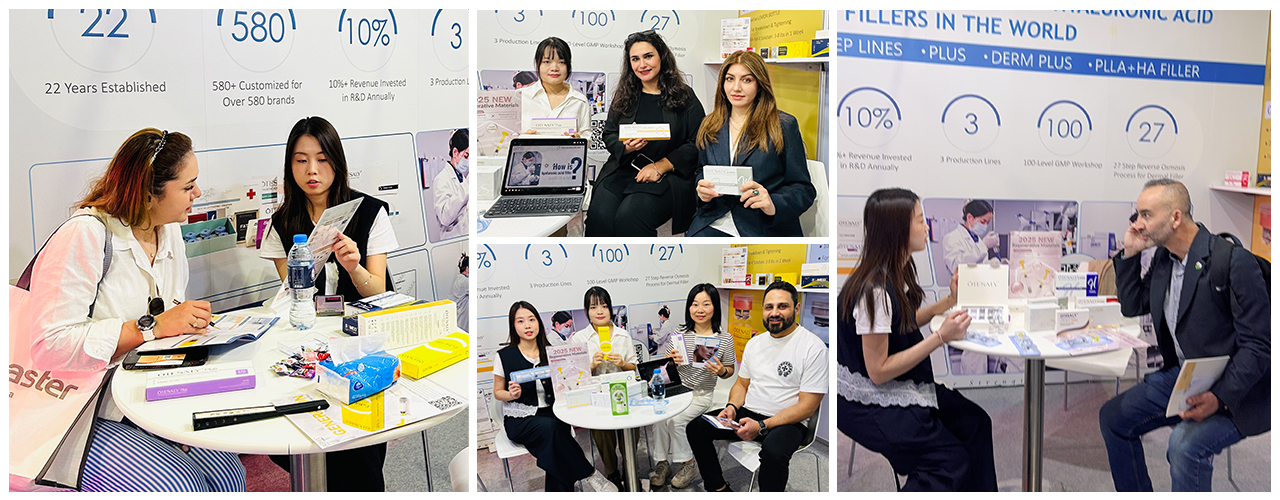
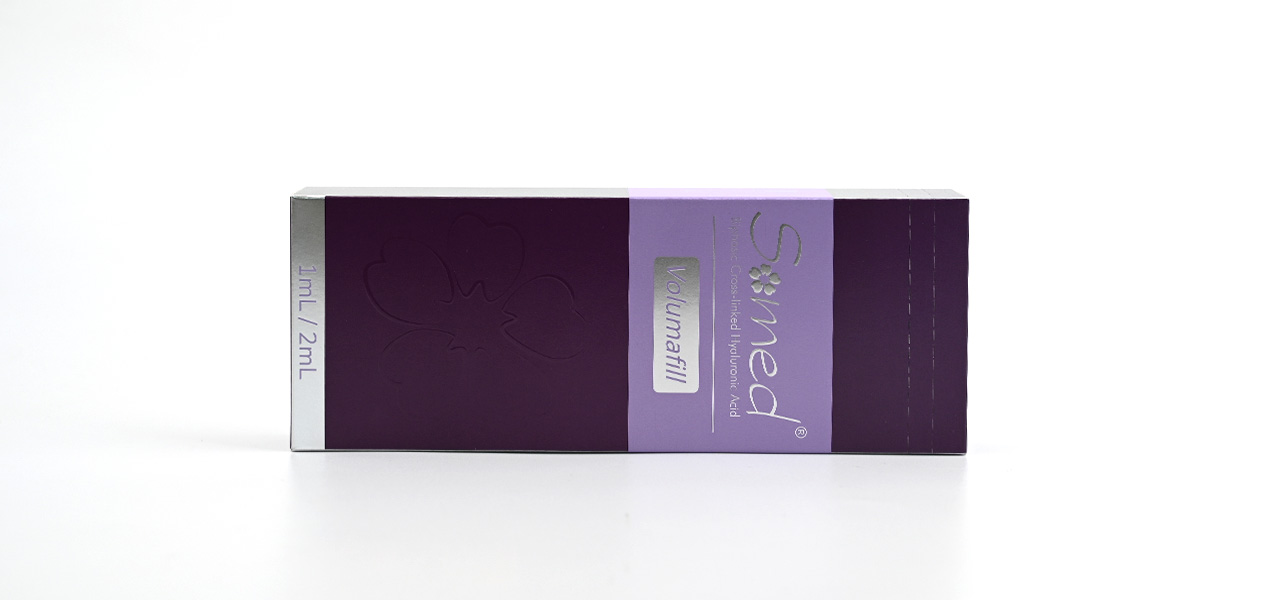
The Dubai clinic purchasing manager we mentioned earlier was one of the contacts we made at that show. We shared batch-specific rheology reports for Volumafill, and ran a live 37℃ G Prime test on our booth rheometer so he could see the consistency first-hand. He placed an initial 50-unit order to use for touch-up treatments for patients who had experienced issues with the previous bad batch, and our clinical team trained his injectors on optimal injection planes for the product. After three months of use, he reported zero complaints of nodules or migration. Volumafill is now their go-to product for all facial contouring treatments, and the clinic opened a second location in Abu Dhabi last month.
Consistent G Prime performance comes down to a supplier’s quality control systems, raw material standards, and technical expertise. As a recipient of the “Top 10 Dermal Filler Manufacturers” industry award, AIMA International Group Co., Ltd. has focused exclusively on dermal filler production since our founding in 2003, delivering custom solutions for over 521 brands worldwide. We have compiled a short list of non-negotiable checks to run when selecting a supplier:

The Barcelona startup founder we mentioned earlier now works with our team long-term. We developed a custom formulation for her brand, tuned to 410Pa G Prime to match her brand’s focus on natural-looking midface support, and supported her with custom packaging design. Her first trial order was just 1,000 units. Since relaunching, her product has earned a 96% positive review rate, with monthly orders holding steady at over 3,000 units and a 47% repurchase rate. She hosted her first offline brand launch event in Madrid earlier this year.
Many new entrants to the aesthetic industry select fillers based on flashy packaging, low wholesale prices, and catchy marketing slogans. They rarely dig into the fine details of parameters like G Prime buried in test reports. When clinical issues pop up, costing them money and eroding hard-won customer trust, they realize these unseen parameters are what make or break a brand’s long-term success. We have manufactured fillers for 23 years, and watched countless brands blow up overnight on viral marketing, only to disappear just as fast when product quality fails to match the hype. Tuning every parameter to match real clinical needs, and holding every batch to consistent quality standards, delivers far more long-term value than any polished marketing campaign.

Copyright @ 2026 AIMA International Group Co., Ltd.